

Description
Send web push notifications to your visitors’ browsers and devices using Firebase Cloud Messaging (FCM HTTP v1). Visitors opt in from the frontend with a single toggle button; from there you can notify them manually, automatically in response to any WordPress or plugin event, or through scheduled and recurring campaigns with click and conversion analytics. There is no limit on how many subscribers you collect.
Two ways to connect
- Managed notification service — get a free NotifReach license in one click from the plugin settings and start sending straight away: no Google Cloud project, no Firebase project, no OAuth setup. A free license covers 5,000 notifications per calendar month, on one site.
- Your own Firebase project — connect your Google OAuth2 client and your Firebase credentials, and your site talks to FCM directly, with no volume limit and no third-party service in between.
You pick one in Settings Connection and can switch at any time. The managed service is preselected on a new install, but it stays entirely inactive until you ask for a license: nothing leaves your site before you click.
Collecting subscribers
- Subscribe/unsubscribe toggle button via shortcode, reflecting its state with
subscribed/unsubscribedCSS classes. - Subscription modal whose content comes from a dedicated, translatable custom post type (“Subscription modal templates”) edited with the native WordPress editor — not indexed on the frontend.
- All subscription fields are optional and selectable (phone, email, first name, last name). Only the device token is required; an email is needed only if you want to create or link a WordPress user account.
- Decoupled feedback messages: a feedback shortcode you can place anywhere, rendered inline, as native WordPress (Gutenberg) snackbar toasts, or both. A JavaScript event is also dispatched for fully custom rendering.
- Placement and styling presets for the button and the modal (inline or fixed corners, accent colour, custom classes), with a shortcode builder and live preview in the settings.
- Works with any form plugin or custom UI: bind the plugin to your own selectors, or trigger a subscription by dispatching the
icfp:external-subscribeJavaScript event. - Resilient subscriptions: device tokens are refreshed automatically when they rotate, renewed subscriptions are recovered by the service worker, and dead tokens are pruned.
Sending notifications
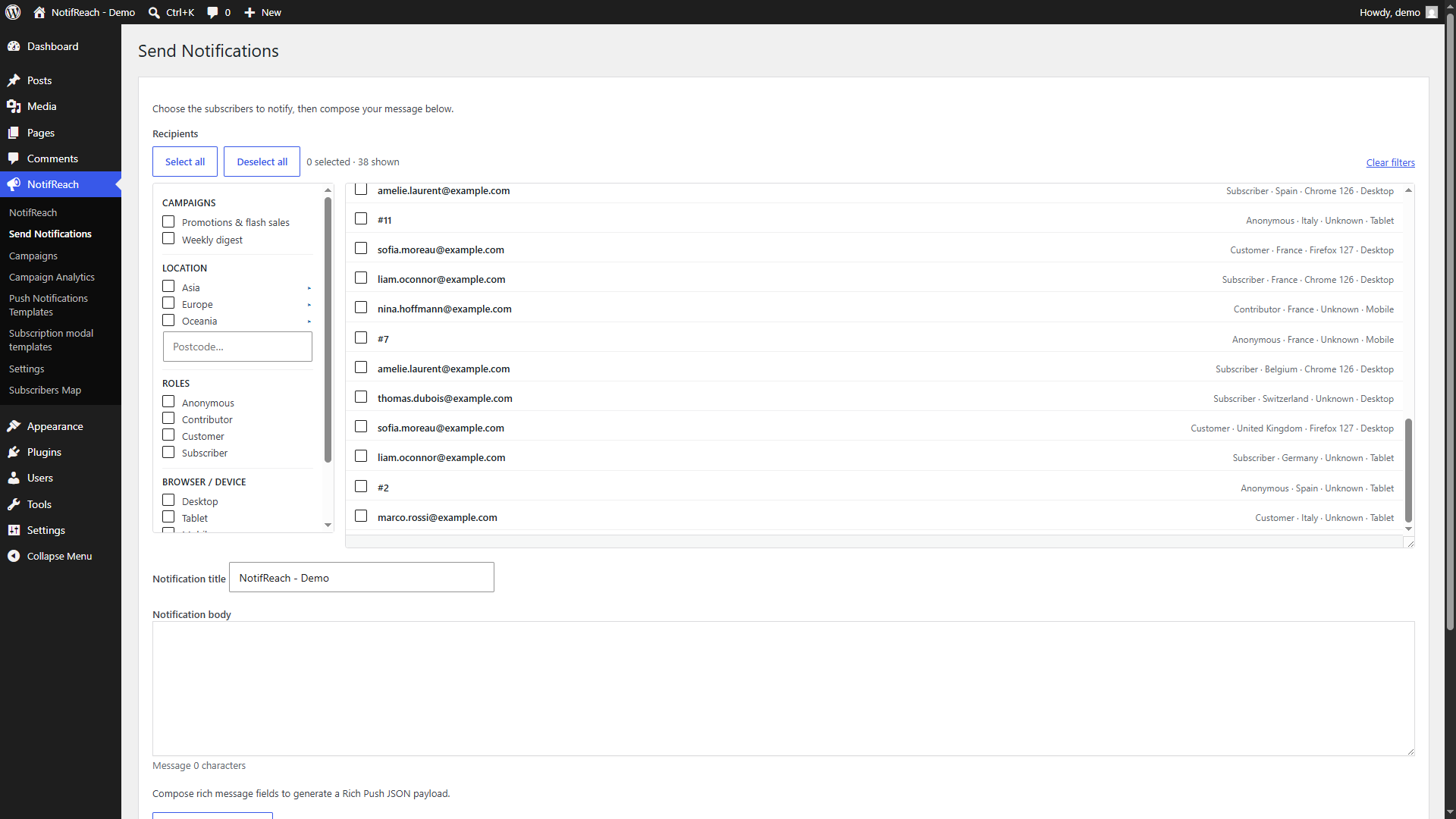
- Send screen with a filterable, paginated recipient selector (filter by campaign, location, role, browser/device; select across the whole filtered list) and a rich message composer: title, body, click URL with a page/post picker, icon, badge, hero image, media pickers, live preview, and action buttons that each open their own URL.
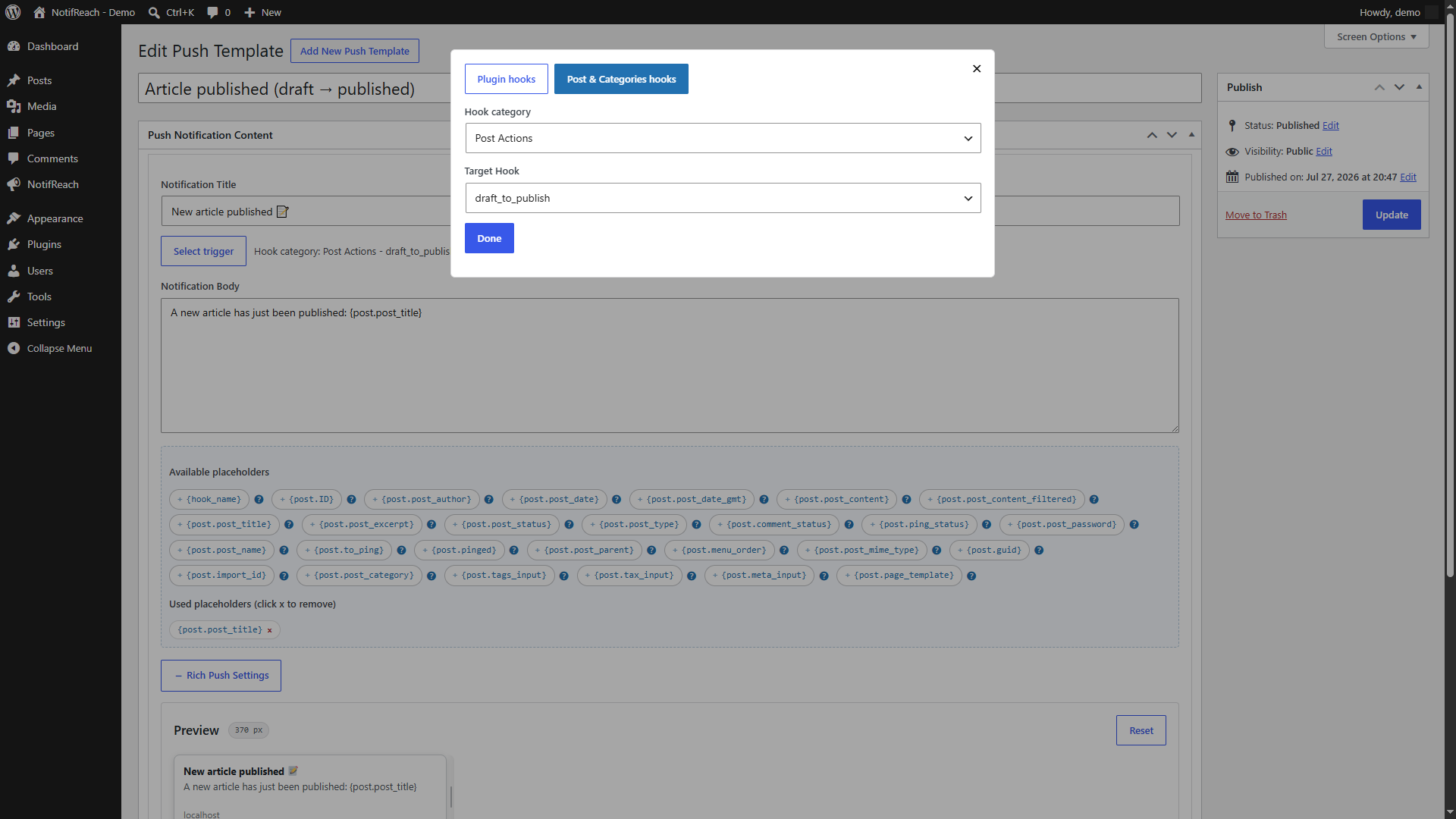
- Hook-triggered notifications: build notification templates (custom post type) bound to any WordPress or plugin action hook, with dynamic placeholders resolved from the hook arguments. A hook knowledge base and a plugin hook scanner help you find the right event.
- Ready-made templates are bundled with the plugin and installed on activation. You can also import a template from a
.jsonfile (file picker or drag & drop) from the Push Templates screen; duplicate and near-duplicate templates are detected on import. - Multilingual routing: the subscriber’s language is stored and matched to the template language (Polylang / WPML aware).
Campaigns
- Three campaign types: permanent (send on demand), scheduled (one-off, with optional daily/weekly/monthly recurrence), or triggered by a WordPress event.
- Audience targeting by user role, by anonymous visitors (subscribers with no account), by language, or by an explicit list of subscribers.
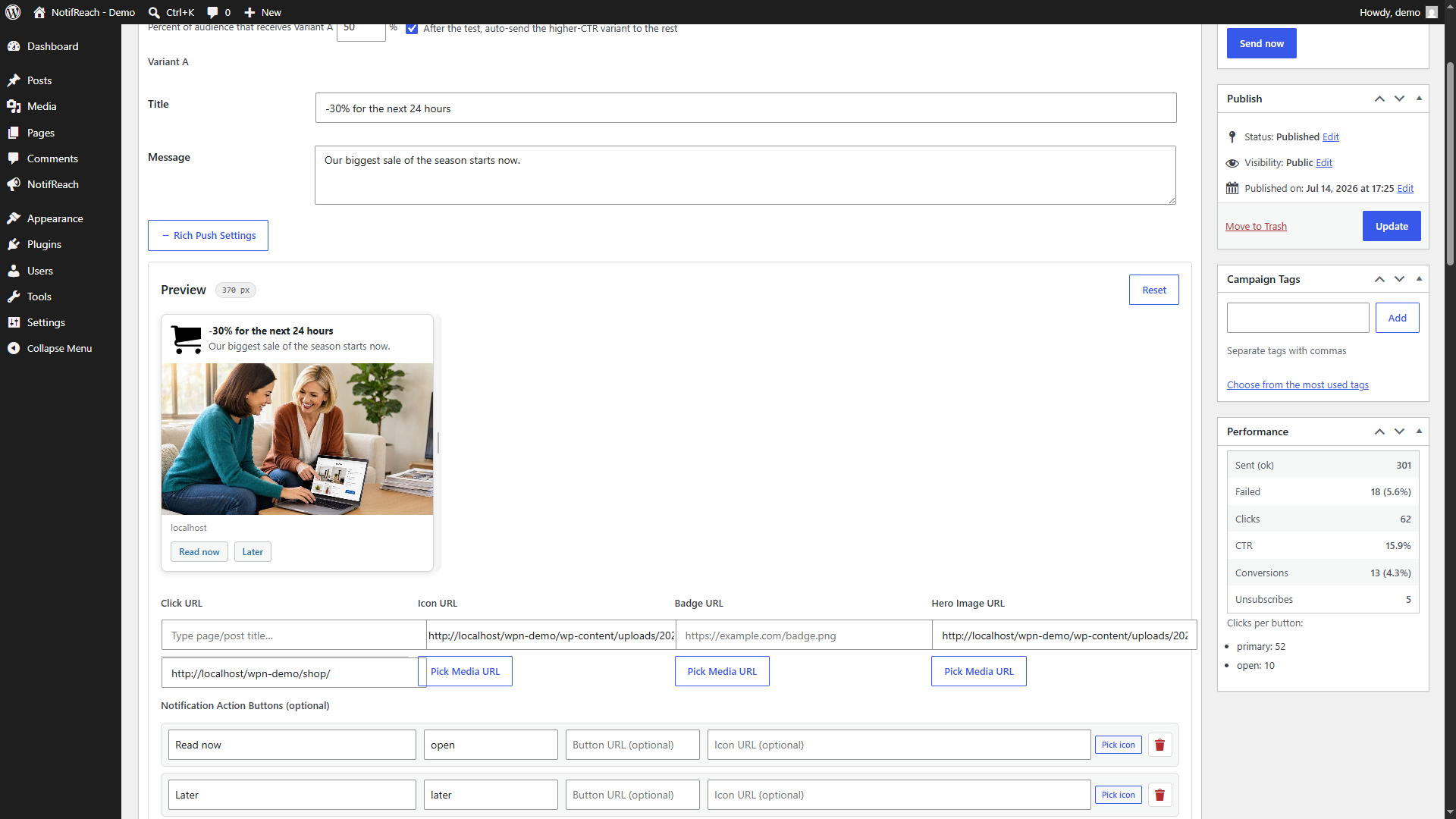
- A/B testing: two variants, a configurable audience split, and optional auto-send of the higher-CTR variant to the rest of the audience.
- UTM parameters and conversion goals on the click URL, with click and conversion tracking.
- Frequency capping: cap how many pushes a subscriber can receive within a rolling window.
- Test send to your own devices before sending to the full audience.
Measuring and managing
- Campaign Analytics: subscribers, active devices, sent, failed, clicks, CTR, conversions, CVR and unsubscribes, filterable by period, granularity, role and campaign, with CSV export.
- Subscribers Map: an optional geolocation captured at subscription time, reverse-geocoded via OpenStreetMap, shown on a map with cascading filters (continent, country, region, postcode, role, browser, device) and a synchronised table.
- Subscriber preference center: a frontend page where visitors opt in or out of individual campaigns, subscribe on the spot, or unsubscribe.
- Passwordless account link: subscribers with a linked account receive a login link by push (delivered instantly) and, optionally, by email.
Reliable scheduling
Scheduled and recurring campaigns run through WP-Cron, a server crontab, or an external service such as cron-job.org calling the plugin’s cron endpoint.
GDPR-ready
- Consent banner: a first-visit banner (on/off, with fully editable and translatable text) asking visitors to accept or decline non-essential campaign-tracking cookies and geolocation capture. Declining never blocks the subscription itself.
- Built into WordPress’s own privacy tools: subscriber data is exportable and erasable from Tools Export/Erase Personal Data like any other personal data on your site — no separate privacy plugin required.
- Self-service data requests: visitors can request an export or deletion of their own data straight from the subscriber preference center, without needing site-admin access.
- Subscribers screen: search any subscriber by phone, email or linked account name and erase them on demand, with the option to also remove their linked WordPress user account.
Developer-friendly
No coding required for the core experience — shortcodes, visual template editors and point-and-click settings get you running. For teams who want to go further:
- A public PHP API (
ICodePlugins\FirebasePush\API) for sending, managing subscribers and reading metrics. - Authenticated REST routes under
icfp/v1(usable with WordPress Application Passwords) to send notifications, run campaigns, read metrics and manage subscribers. - Actions and filters throughout —
icfp_subscriber_recorded,icfp_save_subscriber,icfp_delete_subscriber,icfp_rest_capability,icfp_webpush_urgency, and more. - Fully translatable (text domain matches the plugin slug; an up-to-date
.potis included in/languages; translations are provided via translate.wordpress.org).
Shortcodes
[icodeplugins_firebase_subscribe_btn]— the subscribe/unsubscribe toggle button. Optional attributes:label,class,parent(CSS selector to move the button into),modal(target a specific modal template by ID or slug).[icodeplugins_firebase_subscribe_feedback]— the feedback region. Optional attributes:class,parent,display=inline(default),toast, orboth.[icodeplugins_firebase_subscribe_assets]— loads the subscription assets on a page that renders its own custom subscribe UI.[icodeplugins_notification_preferences]— the subscriber preference center.
How it works
Subscriptions are created in the browser using the Firebase JavaScript SDK and a Web Push VAPID key; the resulting FCM device token is stored in your site database, together with whichever optional fields you chose to collect.
Delivery then follows whichever connection method you chose. In managed mode the site forwards the message to the NotifReach service, which delivers it to FCM on your behalf using its own Google account — so you never create one. In self-hosted mode the site authenticates to Google with your own OAuth2 client and calls the FCM HTTP v1 API directly, and no other service is involved at any point.
External services
Web push cannot work without a push service: the browser vendors require one, and this plugin uses Google Firebase Cloud Messaging (FCM) — through the Firebase project you own and configure, or, if you choose the managed connection method, through the one operated by ICodePlugins. Two further services (OpenStreetMap) are used only by the optional Subscribers Map.
This plugin connects to the following third-party services.
1. Firebase Cloud Messaging — HTTP v1 API (Google)
Hosts: https://fcm.googleapis.com
What it is / why: the push service that actually delivers notifications to your subscribers’ browsers. It is required for the plugin to send anything at all.
Data sent, and when: every time a notification is sent (manually, by a campaign, or by a hook-triggered template), the plugin sends the message content (title, body, icon/badge/image URLs, click URL, action buttons) together with the recipient’s FCM device token. No other subscriber data (email, phone, name, coordinates) is ever sent.
Terms of service: https://firebase.google.com/terms/ — Privacy policy: https://policies.google.com/privacy
2. Google OAuth 2.0 / Google APIs (Google)
Hosts: https://accounts.google.com, https://oauth2.googleapis.com, https://www.googleapis.com
What it is / why: authenticates your site to your own Firebase project, so it can call the FCM API above.
Data sent, and when: when the administrator clicks “Connect Google Account” (browser redirect to Google), then whenever an access token must be issued or refreshed before a send, and once more if the administrator clicks “Disconnect” (token revocation). Only your own OAuth client ID/secret and the authorization/refresh tokens are exchanged. No subscriber data is involved.
Terms of service: https://policies.google.com/terms — Privacy policy: https://policies.google.com/privacy
3. Firebase JavaScript SDK (Google)
Hosts: https://firebaseinstallations.googleapis.com, https://fcmregistrations.googleapis.com (contacted by the SDK; the SDK files themselves are bundled with the plugin and served from your own domain).
What it is / why: runs in the visitor’s browser and in the service worker to register the browser with FCM and obtain the device token that identifies it.
Data sent, and when: only when a visitor chooses to subscribe (and afterwards, if the browser rotates the token). The browser sends your Firebase project identifiers, your Web Push VAPID public key and the browser’s push subscription details to Google. Nothing is sent for visitors who never subscribe.
Terms of service: https://firebase.google.com/terms/ — Privacy policy: https://policies.google.com/privacy
4. Nominatim — reverse geocoding (OpenStreetMap Foundation)
Host: https://nominatim.openstreetmap.org
What it is / why: turns the coordinates a subscriber agreed to share into a readable address (country, region, postcode) for the optional Subscribers Map.
Data sent, and when: only if a visitor explicitly grants the browser’s location permission when subscribing. The plugin then sends those coordinates (latitude/longitude) and an identifying User-Agent, once per subscriber. If permission is denied — or the browser prompt is dismissed — nothing is collected and nothing is sent. No personal detail (email, phone, name, device token) is sent.
Terms of service: https://osmfoundation.org/wiki/Terms_of_Use — Nominatim usage policy: https://operations.osmfoundation.org/policies/nominatim/ — Privacy policy: https://osmfoundation.org/wiki/Privacy_Policy
5. OpenStreetMap map tiles (OpenStreetMap Foundation)
Host: https://tile.openstreetmap.org
What it is / why: supplies the background map images of the Subscribers Map screen. (The map library, Leaflet, is bundled with the plugin — it is not loaded from a CDN.)
Data sent, and when: only when an administrator opens the Subscribers Map admin screen, and only what any image request carries — the administrator’s IP address and browser user-agent. No visitor or subscriber data is sent. No tile is requested on the front end.
Tile usage policy: https://operations.osmfoundation.org/policies/tiles/ — Privacy policy: https://osmfoundation.org/wiki/Privacy_Policy
6. NotifReach notification service (ICodePlugins) — managed connection method only
Host: https://wpwpnpluginserver.icodeplugins.com
What it is / why: the optional managed sending service operated by ICodePlugins, which delivers your notifications to FCM on your behalf so you do not have to create a Google Cloud project or a Firebase project. It is used only if you select the managed connection method in Settings Connection.
Data sent, and when:
* when the administrator clicks “Get my free license” — this site’s address, the email address the administrator typed in that form, and a random secret generated by this site to prove later requests come from it;
* when the administrator clicks “Connect to service” — this site’s address and the license key;
* every time a notification is sent while the managed method is active — the message content (title, body, icon/badge/image URLs, click URL, action buttons) and the recipient’s FCM device token. No other subscriber data (email, phone, name, coordinates) is ever sent;
* on a periodic service health check — only the access token the service issued to this site.
No request is made to this service unless the administrator selects the managed method and clicks one of those buttons. In self-hosted mode the plugin never contacts it, and disconnecting stops it entirely.
Terms of service: https://icodeplugins.com/en/terms/ — Privacy policy: https://icodeplugins.com/en/privacy-policy/
Privacy and consent
- The plugin does not track visitors, does not profile them and contains no analytics. Nothing is collected from a visitor who does not subscribe.
- Subscribing is always an explicit action: the visitor clicks the subscribe button and then grants the browser’s own notification permission.
- Geolocation is opt-in twice: the feature is optional for you, and the visitor must grant the browser’s location permission. Refusing changes nothing else — the subscription still works.
- The subscriber’s browser/device (from the user-agent) is recorded on your own server to display it in the Subscribers Map. It is never sent to a third party.
- Subscriber details (email, phone, name, coordinates, addresses) are stored on your own site only, in your own database, and are deleted with the plugin’s data when you uninstall it.
- Clicks and conversions are counted per campaign for your analytics; they are stored on your site only.
Please make sure your site’s privacy policy reflects the use of Firebase/Google (and OpenStreetMap, if you enable the Subscribers Map).
Included in the Pro version:
- Unlimited sending through the managed service — no monthly quota
- Real Linux CRON jobs for reliable delivery in a couple clicks
- Download and share push notification templates from the premium catalog
- Multi-site licenses
Screenshots


Installation
- Upload the plugin to
/wp-content/plugins/and activate it. - In NotifReach Settings Connection, enter your Firebase configuration (Project ID, API Key, App ID, Messaging Sender ID, Auth Domain), the Web Push VAPID key, and connect your Google OAuth2 client (Client ID / Client Secret).
- Under Settings Subscription fields, choose which optional fields to collect.
- Create at least one Subscription modal template (the content shown inside the subscribe modal).
- Add
[icodeplugins_firebase_subscribe_btn]to a page or template, and optionally[icodeplugins_firebase_subscribe_feedback]near it. (The Integration tab can also render them for you.) - (Optional) Create Push Templates bound to the hooks you want to trigger notifications, or start from the bundled ones.
- (Optional) Create a page with
[icodeplugins_notification_preferences]so subscribers can manage their notifications.
Your site must be served over HTTPS for web push to work.
FAQ
-
Is an email address required to subscribe?
-
No. Every subscription field — phone number, email, first name, last name — is optional and you choose which ones to show. Only the browser’s push token is required to receive notifications. Providing an email lets NotifReach create or link a WordPress user account for the subscriber, which unlocks the passwordless account link (a one-click login sent by push or email).
-
Do I need a Firebase account?
-
No, not any more. With the managed connection method you get a free NotifReach license in one click and start sending immediately — no Google account, no Google Cloud project, no Firebase project. You still can use your own Firebase project if you prefer: choose the self-hosted method in the Connection settings and the plugin will talk to FCM directly with your own credentials.
-
What are the limits of the free license?
-
5,000 notifications per calendar month, on one site, with no expiry date. When the limit is reached, sending resumes on the 1st of the following month — or immediately with NotifReach Pro, which has no quota. The number of subscribers you collect is never limited, whichever method you use.
-
Can I change connection method later?
-
Yes, at any time in Settings Connection. Your subscriber list is kept. A push token belongs to the Firebase project that issued it, so the tokens you already hold stop working the moment you switch — but each subscriber is migrated automatically, with no action on their part, the next time they visit your site: the browser permission they granted still stands, and the plugin swaps their old token for a new one. Until a given subscriber comes back, that device will not receive notifications.
-
My scheduled campaigns go out late. Why?
-
WP-Cron only runs when someone visits your site, so a low-traffic site fires it late. Use a real server crontab, or an external service such as cron-job.org, to call the plugin’s cron endpoint on a fixed schedule.
-
Why don’t role-targeted campaigns reach most of my subscribers?
-
Filtering by user role only reaches subscribers linked to a WordPress account. Most visitors subscribe anonymously, so tick Anonymous (no user account) in the campaign’s Audience box, alone or alongside roles. Leaving everything unchecked targets all subscribers.
-
A notification was accepted but did not appear on Brave (mobile). Why?
-
Brave on Android disables Google services for push messaging by default. Enable “Use Google services for push messaging” in Brave’s settings, restart Brave, then subscribe again. On iOS, web push requires iOS 16.4+ and the site to be installed to the Home Screen (PWA).
-
Does it support translations?
-
Yes. The plugin is fully internationalized; a
.potfile is provided in/languages, and translations are handled via translate.wordpress.org. Subscriber and template languages are matched, with Polylang / WPML support. -
Is HTTPS required?
-
Yes. Browsers only allow web push and service workers on secure origins.
Reviews
There are no reviews for this plugin.
Contributors & Developers
“NotifReach: Push Notifications” is open source software. The following people have contributed to this plugin.
Contributors
“NotifReach: Push Notifications” has been translated into 1 locale. Thank you to the translators for their contributions.
Translate “NotifReach: Push Notifications” into your language.
Interested in development?
Browse the code, check out the SVN repository, or subscribe to the development log by RSS.
Changelog
1.3.0
- New: send without a Google account. A free NotifReach license, obtained in one click from Settings Connection, lets this plugin send through the managed NotifReach service — no Google Cloud project, no Firebase project, no OAuth setup. A free license covers 5,000 notifications per calendar month on one site; the number of subscribers stays unlimited.
- The Connection settings now offer two methods: the managed service (preselected on a new install) and your own Google Cloud & Firebase credentials, exactly as before. You can switch at any time.
- Existing sites are not changed. A site that already has its own Firebase project configured stays on the self-hosted method after this update and keeps working exactly as it did. The new default only applies to fresh installs.
- The service is inert until you ask for a license: no request is made to it before an administrator clicks. See the new entry in the External services section for exactly what is sent, and when.
- Added the
modefield to the REST/statusresponse andAPI::active_mode()to the PHP API, so integrations can tell which connection method is active.
1.2.0
- Fixed duplicate notifications when WordPress fires more than one hook for the same action (e.g.
draft_to_publishandpublish_postboth firing when a draft is published), including when a Campaign and a Template were both bound to it. Every Push Template now has its own “also send its own notification when its trigger fires” toggle, decoupled from its Published/Draft status, so its content stays usable by a Campaign without also firing on its own — see the new Active Triggers screen (NotifReach Active Triggers) for an at-a-glance view of every hook currently bound to a Template and/or a Campaign. - Fixed notifications incorrectly firing when editing or republishing the plugin’s own admin content (Templates, Campaigns, Subscription modals, Consent banner text), since generic hooks like
draft_to_publishfire for every post type, not just real site content. - Added stronger duplicate-send protection for hook-triggered Templates and event-triggered Campaigns against a hook firing more than once for what feels like a single action (e.g. the block editor’s autosave and publish requests landing on the same hook in separate requests), and client-side de-duplication for the rare case a push is otherwise delivered twice to the same device.
- Event-triggered Campaigns can now use dynamic
{post.X}-style placeholders in their message (title, body, icon, image, click URL, action button URLs), resolved from the triggering event — the same placeholder syntax already available in hook-triggered Templates. Clicking a link in such a notification now reliably lands on the destination that was resolved at send time. - Added the
{argName.featured_image}placeholder — the triggering post’s featured image URL, available for hook-triggered Templates and event-triggered Campaigns alike, including for native WordPress hooks. - Performance fix: selecting a native WordPress hook (not tied to a specific plugin) in the template/campaign trigger picker no longer scans every installed plugin’s files.
1.1.0
- GDPR-ready: a first-visit consent banner (on/off, fully editable and translatable text) gates non-essential campaign-tracking cookies and geolocation capture; subscriber data is exportable and erasable from WordPress’s own Tools Export/Erase Personal Data; visitors can request their own data export/erasure from the preference center; a new Subscribers screen lets admins search and erase subscribers on demand, with the option to also remove their linked WordPress user account.
- Auto-open subscription modal: trigger the modal automatically, with or without a visible button, after a load delay or a period of inactivity, and/or once the visitor scrolls past a threshold — with a configurable reappearance policy (once per session, cooldown in days, or every time).
1.0.0
- Initial release: web push notifications via Firebase Cloud Messaging (FCM HTTP v1), sent with your own Firebase project and Google OAuth2 client.
- Frontend subscribe/unsubscribe toggle button and translatable subscription modal (custom post type), with every subscription field optional.
- Feedback shortcode with inline and native WordPress snackbar toast rendering, plus a JavaScript event for custom UIs and form plugins.
- Send screen: filterable, paginated recipient selector and a rich message composer (icon, badge, hero image, action buttons, live preview).
- Hook-triggered notification templates with dynamic placeholders, a WordPress hook knowledge base and a plugin hook scanner. Bundled ready-made templates; import more from a
.jsonfile, with duplicate detection. - Campaigns: permanent, scheduled/recurring and event-triggered, with audience targeting, A/B testing, UTM and conversion goals, frequency capping and test sends.
- Campaign Analytics with CSV export, and a Subscribers Map with geolocation and segmentation filters.
- Subscriber preference center and passwordless account link (by push and, optionally, by email).
- Multilingual routing (Polylang / WPML aware), a public PHP API and authenticated REST routes under
icfp/v1.